 AnimatedDrawings
Code to accompany "A Method for Animating Children's Drawings of the Human Figure"
Top Related Projects

T2I-Adapter

Let us control diffusion models!

A latent text-to-image diffusion model

CLIP (Contrastive Language-Image Pretraining), Predict the most relevant text snippet given an image

Cross-platform, customizable ML solutions for live and streaming media.
Quick Overview
AnimatedDrawings is an open-source project by Facebook Research that brings children's drawings to life through animation. It allows users to upload a hand-drawn character, which is then rigged and animated automatically. The project aims to make character animation accessible to non-experts and children.
Pros
- Easy to use, requiring no animation expertise
- Supports a wide range of hand-drawn character styles
- Provides a web interface for easy access and usage
- Open-source, allowing for community contributions and improvements
Cons
- Limited to 2D character animations
- May struggle with complex or unconventional character designs
- Requires a decent quality scan or photo of the drawing for best results
- Animation options are somewhat limited compared to professional tools
Code Examples
# Load a character from an image file
character = ad.load_character("path/to/character_image.png")

# Rig the character automatically
rigged_character = ad.rig_character(character)

# Apply a pre-defined animation to the character
animated_character = ad.animate_character(rigged_character, "dance")
# Create a custom animation sequence
animation_sequence = [
    {"pose": "wave", "duration": 2},
    {"pose": "jump", "duration": 1},
    {"pose": "spin", "duration": 3}
]

# Apply the custom animation to the character
custom_animated_character = ad.animate_character(rigged_character, animation_sequence)
# Export the animated character as a video
ad.export_video(animated_character, "output_video.mp4")
Getting Started
To get started with AnimatedDrawings:
-
Clone the repository:
git clone https://github.com/facebookresearch/AnimatedDrawings.git -
Install dependencies:
pip install -r requirements.txt -
Run the web interface:
python -m animated_drawings.web_app -
Open a web browser and navigate to
http://localhost:8080to use the tool.
Competitor Comparisons
T2I-Adapter
Pros of T2I-Adapter
- Focuses on text-to-image generation with additional control inputs
- Supports various control types (depth, canny edge, pose, etc.)
- More versatile for different image generation tasks
Cons of T2I-Adapter
- Requires more complex input preparation (control images)
- May have a steeper learning curve for beginners
- Less specialized for character animation tasks
Code Comparison
AnimatedDrawings:
character = create_character_from_drawing('path/to/drawing.png')
motion = create_motion_from_bvh('path/to/motion.bvh')
animate_character(character, motion)
T2I-Adapter:
prompt = "A person standing in a forest"
control_image = load_control_image('path/to/depth_map.png')
generated_image = generate_image(prompt, control_image, control_type='depth')
Summary
AnimatedDrawings specializes in bringing 2D drawings to life through animation, while T2I-Adapter focuses on controlled text-to-image generation. AnimatedDrawings is more user-friendly for character animation tasks, whereas T2I-Adapter offers greater flexibility for various image generation scenarios but may require more technical expertise.
Let us control diffusion models!
Pros of ControlNet
- More versatile, supporting various image-to-image tasks beyond animation
- Offers more advanced control over generated images
- Larger community and more frequent updates
Cons of ControlNet
- Steeper learning curve due to its complexity
- Requires more computational resources
- Less focused on character animation specifically
Code Comparison
AnimatedDrawings:
from animated_drawings import render_sketch
render_sketch(input_image, output_path)
ControlNet:
from controlnet import generate_image
generate_image(input_image, control_map, prompt)
AnimatedDrawings focuses on simplifying the process of animating sketches, while ControlNet provides more granular control over image generation tasks. AnimatedDrawings is more accessible for users specifically interested in character animation, whereas ControlNet offers a broader range of applications in image manipulation and generation.
Both projects contribute significantly to the field of AI-powered image processing, with AnimatedDrawings excelling in its niche of sketch animation and ControlNet providing a more comprehensive toolkit for various image-to-image tasks.
A latent text-to-image diffusion model
Pros of Stable-diffusion
- More versatile, capable of generating a wide range of images
- Larger community and more active development
- Better documentation and resources for implementation
Cons of Stable-diffusion
- Higher computational requirements
- More complex to set up and use
- Less specialized for character animation tasks
Code Comparison
AnimatedDrawings:
from animated_drawings import render_sketch
sketch = render_sketch("input_image.jpg")
animate_sketch(sketch, "dance_motion.json")
Stable-diffusion:
from diffusers import StableDiffusionPipeline
pipe = StableDiffusionPipeline.from_pretrained("runwayml/stable-diffusion-v1-5")
image = pipe("A beautiful landscape with mountains").images[0]
AnimatedDrawings focuses on creating animated characters from sketches, while Stable-diffusion is a more general-purpose image generation model. AnimatedDrawings is simpler to use for its specific task, but Stable-diffusion offers broader capabilities at the cost of increased complexity.
CLIP (Contrastive Language-Image Pretraining), Predict the most relevant text snippet given an image
Pros of CLIP
- More versatile for general image-text understanding tasks
- Larger community and broader applications in AI research
- Pre-trained on a vast dataset, enabling zero-shot learning capabilities
Cons of CLIP
- Higher computational requirements for inference
- Less specialized for animation-specific tasks
- Steeper learning curve for implementation in specific use cases
Code Comparison
AnimatedDrawings focuses on creating animations from drawings:
from animated_drawings import render_sketch
render_sketch("input_sketch.png", "output_animation.mp4")
CLIP is used for image-text matching and understanding:
import clip
model, preprocess = clip.load("ViT-B/32")
image = preprocess(Image.open("image.jpg")).unsqueeze(0)
text = clip.tokenize(["a dog", "a cat"])
logits_per_image, logits_per_text = model(image, text)
AnimatedDrawings is more specialized for turning sketches into animations, while CLIP offers broader image-text understanding capabilities. CLIP's versatility comes at the cost of higher complexity and resource requirements, whereas AnimatedDrawings provides a more focused solution for animation tasks.
Cross-platform, customizable ML solutions for live and streaming media.
Pros of MediaPipe
- More comprehensive and versatile, offering a wide range of ML solutions for various tasks
- Better performance and optimization for real-time applications, especially on mobile devices
- Larger community and more extensive documentation
Cons of MediaPipe
- Steeper learning curve due to its complexity and broader scope
- May be overkill for simple animation projects
- Less focused on character animation specifically
Code Comparison
MediaPipe (C++):
#include "mediapipe/framework/calculator_framework.h"
#include "mediapipe/framework/formats/landmark.pb.h"

class PoseLandmarkCalculator : public CalculatorBase {
 public:
  static absl::Status GetContract(CalculatorContract* cc);
  absl::Status Process(CalculatorContext* cc) override;
};
AnimatedDrawings (Python):
from animated_drawings import render
from animated_drawings.model import AnimatedDrawing

ad = AnimatedDrawing("path/to/drawing.png")
render(ad, "path/to/output.mp4")
MediaPipe offers a more complex, low-level API suitable for various ML tasks, while AnimatedDrawings provides a simpler, high-level API specifically for animating drawings. MediaPipe's versatility comes at the cost of complexity, whereas AnimatedDrawings offers ease of use for its specific purpose.
Convert  designs to code with AI
Introducing Visual Copilot: A new AI model to turn Figma designs to high quality code using your components.
Try Visual CopilotREADME
Animated Drawings
Update 09-03-25: This project has been a joy to share with you all. Thanks to this community for your creativity and support along the way. I'm moving on to new adventures and won't be able to maintain this repository anymore, so I've chosen to archive it. If you have questions or want to say hello in the future, come find me at www.hjessmith.com.
This repo contains an implementation of the algorithm described in the paper, A Method for Animating Children's Drawings of the Human Figure. In addition, this repo aims to be a useful creative tool in its own right, allowing you to flexibly create animations starring your own drawn characters. Here's a video overview of the project. If you do create something fun with this, let us know! Use hashtag #FAIRAnimatedDrawings, or tag me on twitter: @hjessmith.
Installation
This project has been tested with macOS Ventura 13.2.1 and Ubuntu 18.04. If you're installing on another operating system, you may encounter issues.
We strongly recommend activating a Python virtual environment prior to installing Animated Drawings. Conda's Miniconda is a great choice. Follow these steps to download and install it. Then run the following commands:
    # create and activate the virtual environment
    conda create --name animated_drawings python=3.8.13
    conda activate animated_drawings

    # clone AnimatedDrawings and use pip to install
    git clone https://github.com/facebookresearch/AnimatedDrawings.git
    cd AnimatedDrawings
    pip install -e .
Mac M1/M2 users: if you get architecture errors, make sure your ~/.condarc does not have osx-64, but only osx-arm64 and noarch in its subdirs listing. You can see that it's going to go sideways as early as conda create because it will show osx-64 instead of osx-arm64 versions of libraries under "The following NEW packages will be INSTALLED".
Using Animated Drawings
Quick Start
Now that everything's set up, let's animate some drawings! To get started, follow these steps:
- Open a terminal and activate the animated_drawings conda environment:
~ % conda activate animated_drawings
- Ensure you're in the root directory of AnimatedDrawings:
(animated_drawings) ~ % cd {location of AnimatedDrawings on your computer}
- Start up a Python interpreter:
(animated_drawings) AnimatedDrawings % python
- Copy and paste the follow two lines into the interpreter:
from animated_drawings import render
render.start('./examples/config/mvc/interactive_window_example.yaml')
If everything is installed correctly, an interactive window should appear on your screen. (Use spacebar to pause/unpause the scene, arrow keys to move back and forth in time, and q to close the screen.)

There's a lot happening behind the scenes here. Characters, motions, scenes, and more are all controlled by configuration files, such as interactive_window_example.yaml. Below, we show how different effects can be achieved by varying the config files. You can learn more about the config files here.
Export MP4 video
Suppose you'd like to save the animation as a video file instead of viewing it directly in a window. Specify a different example config by copying these lines into the Python interpreter:
from animated_drawings import render
render.start('./examples/config/mvc/export_mp4_example.yaml')
Instead of an interactive window, the animation was saved to a file, video.mp4, located in the same directory as your script.

Export transparent .gif
Perhaps you'd like a transparent .gif instead of an .mp4? Copy these lines in the Python interpreter instead:
from animated_drawings import render
render.start('./examples/config/mvc/export_gif_example.yaml')
Instead of an interactive window, the animation was saved to a file, video.gif, located in the same directory as your script.

Headless Rendering
If you'd like to generate a video headlessly (e.g. on a remote server accessed via ssh), you'll need to specify USE_MESA: True within the view section of the config file.
    view:
      USE_MESA: True
Animating Your Own Drawing
All of the examples above use drawings with pre-existing annotations. To understand what we mean by annotations here, look at one of the 'pre-rigged' character's annotation files. You can use whatever process you'd like to create those annotations files and, as long as they are valid, AnimatedDrawings will give you an animation.
So you'd like to animate your own drawn character. I wouldn't want you to create those annotation files manually. That would be tedious. To make it fast and easy, we've trained a drawn humanoid figure detector and pose estimator and provided scripts to automatically generate annotation files from the model predictions. There are currently two options for setting this up.
Option 1: Docker
To get it working, you'll need to set up a Docker container that runs TorchServe. This allows us to quickly show your image to our machine learning models and receive their predictions.
To set up the container, follow these steps:
- Install Docker Desktop
- Ensure Docker Desktop is running.
- Run the following commands, starting from the Animated Drawings root directory:
    (animated_drawings) AnimatedDrawings % cd torchserve

    # build the docker image... this takes a while (~5-7 minutes on Macbook Pro 2021)
    (animated_drawings) torchserve % docker build -t docker_torchserve .

    # start the docker container and expose the necessary ports
    (animated_drawings) torchserve % docker run -d --name docker_torchserve -p 8080:8080 -p 8081:8081 docker_torchserve
Wait ~10 seconds, then ensure Docker and TorchServe are working by pinging the server:
    (animated_drawings) torchserve % curl http://localhost:8080/ping

    # should return:
    # {
    #   "status": "Healthy"
    # }
If, after waiting, the response is curl: (52) Empty reply from server, one of two things is likely happening.
- Torchserve hasn't finished initializing yet, so wait another 10 seconds and try again.
- Torchserve is failing because it doesn't have enough RAM. Try increasing the amount of memory available to your Docker containers to 16GB by modifying Docker Desktop's settings.
With that set up, you can now go directly from image -> animation with a single command:
    (animated_drawings) torchserve % cd ../examples
    (animated_drawings) examples % python image_to_animation.py drawings/garlic.png garlic_out
As you waited, the image located at drawings/garlic.png was analyzed, the character detected, segmented, and rigged, and it was animated using BVH motion data from a human actor.
The resulting animation was saved as ./garlic_out/video.gif.


Option 2: Running locally on macOS
Getting Docker working can be complicated, and it's unnecessary if you just want to play around with this locally. Contributer @Gravityrail kindly submitted a script that sets up Torchserve locally on MacOS, no Docker required.
cd torchserve
./setup_macos.sh
torchserve --start --ts-config config.local.properties --foreground
With torchserve running locally like this, you can use the same command as before to make the garlic dance:
python image_to_animation.py drawings/garlic.png garlic_out
Fixing bad predictions
You may notice that, when you ran python image_to_animation.py drawings/garlic.png garlic_out, there were additional non-video files within garlic_out.
mask.png, texture.png, and char_cfg.yaml contain annotation results of the image character analysis step. These annotations were created from our model predictions.
If the mask predictions are incorrect, you can edit the mask with an image editing program like Paint or Photoshop.
If the joint predictions are incorrect, you can run python fix_annotations.py to launch a web interface to visualize, correct, and update the annotations. Pass it the location of the folder containing incorrect joint predictions (here we use garlic_out/ as an example):
    (animated_drawings) examples % python fix_annotations.py garlic_out/
    ...
     * Running on http://127.0.0.1:5050
    Press CTRL+C to quit
Navigate to http://127.0.0.1:5050 in your browser to access the web interface. Drag the joints into the appropriate positions, and hit Submit to save your edits.
Once you've modified the annotations, you can render an animation using them like so:
    # specify the folder where the fixed annoations are located
    (animated_drawings) examples % python annotations_to_animation.py garlic_out
Adding multiple characters to scene
Multiple characters can be added to a video by specifying multiple entries within the config scene's 'ANIMATED_CHARACTERS' list. To see for yourself, run the following commands from a Python interpreter within the AnimatedDrawings root directory:
from animated_drawings import render
render.start('./examples/config/mvc/multiple_characters_example.yaml')


Adding a background image
Suppose you'd like to add a background to the animation. You can do so by specifying the image path within the config. Run the following commands from a Python interpreter within the AnimatedDrawings root directory:
from animated_drawings import render
render.start('./examples/config/mvc/background_example.yaml')


Using BVH Files with Different Skeletons
You can use any motion clip you'd like, as long as it is in BVH format.
If the BVH's skeleton differs from the examples used in this project, you'll need to create a new motion config file and retarget config file. Once you've done that, you should be good to go. The following code and resulting clip uses a BVH with completely different skeleton. Run the following commands from a Python interpreter within the AnimatedDrawings root directory:
from animated_drawings import render
render.start('./examples/config/mvc/different_bvh_skeleton_example.yaml')

Creating Your Own BVH Files
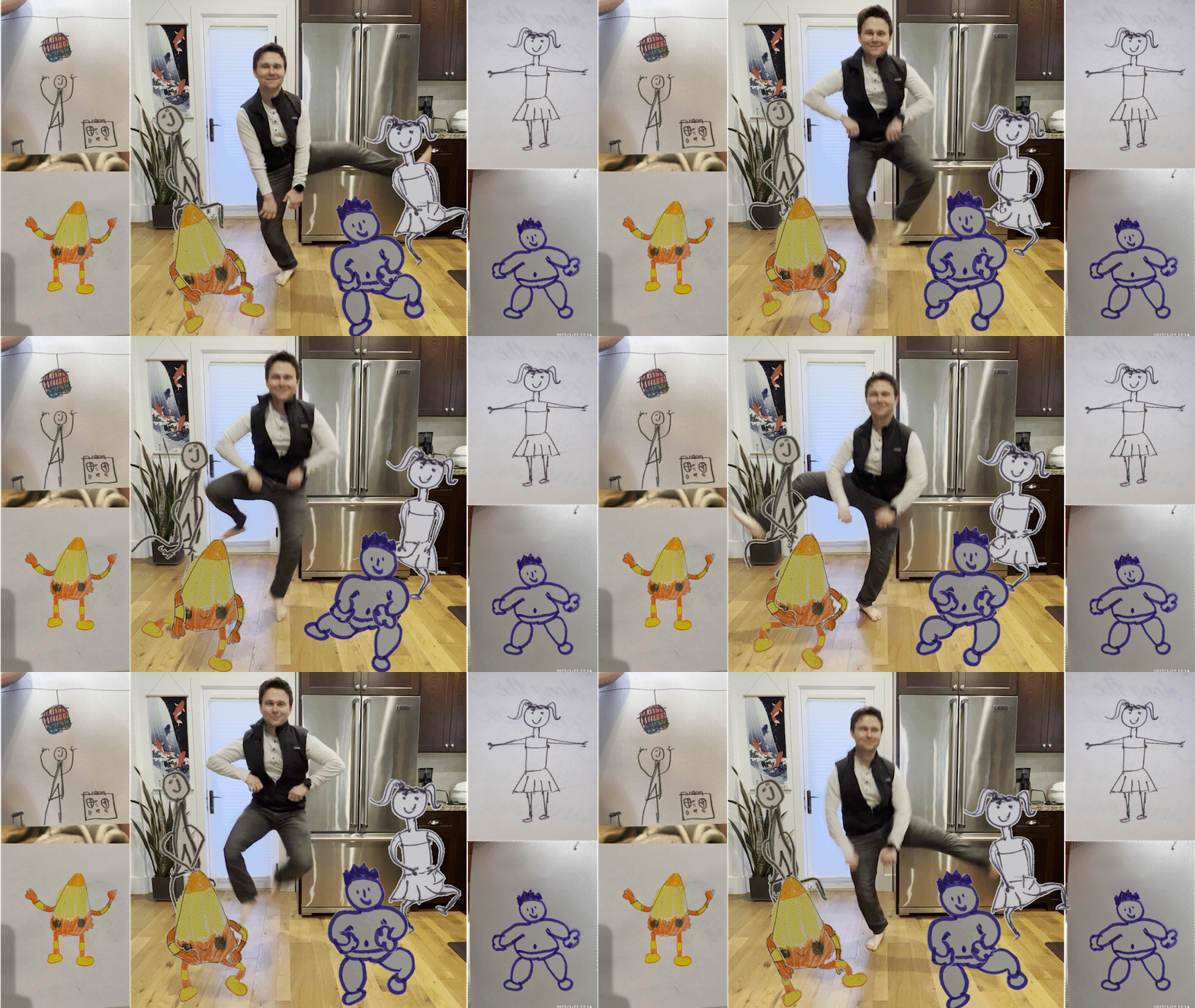
You may be wondering how you can create BVH files of your own. You used to need a motion capture studio. But now, thankfully, there are simple and accessible options for getting 3D motion data from a single RGB video. For example, I created this Readme's banner animation by:
- Recording myself doing a silly dance with my phone's camera.
- Using Rokoko to export a BVH from my video.
- Creating a new motion config file and retarget config file to fit the skeleton exported by Rokoko.
- Using AnimatedDrawings to animate the characters and export a transparent animated gif.
- Combining the animated gif, original video, and original drawings in Adobe Premiere.
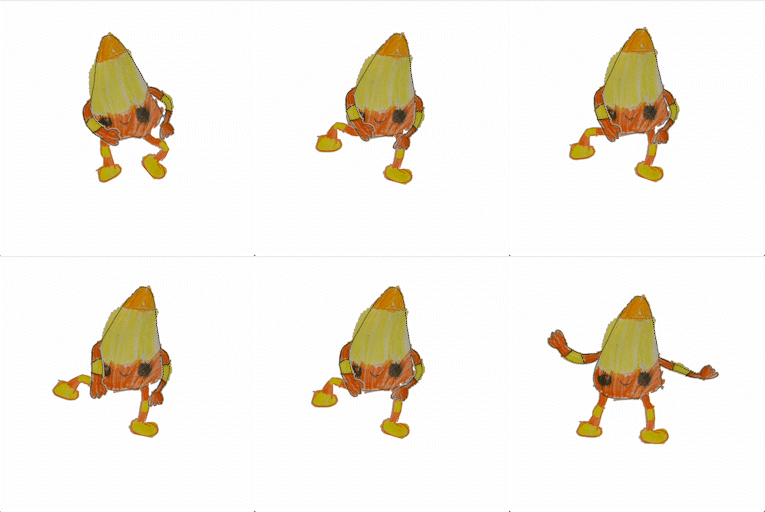
Here is an example of the configs I used apply my motion to a character. To use these config files, ensure that the Rokoko exports the BVH with the Mixamo skeleton preset:
from animated_drawings import render
render.start('./examples/config/mvc/rokoko_motion_example.yaml')
It will show this in a new window:
Adding Addition Character Skeletons
All of the example animations above depict "human-like" characters; they have two arms and two legs.
Our method is primarily designed with these human-like characters in mind, and the provided pose estimation model assumes a human-like skeleton is present.
But you can manually specify a different skeletons within the character config and modify the specified retarget config to support it.
If you're interested, look at the configuration files specified in the two examples below.
from animated_drawings import render
render.start('./examples/config/mvc/six_arms_example.yaml')
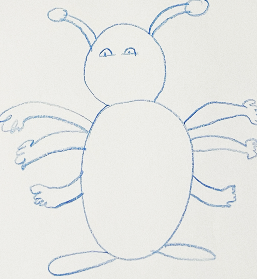

from animated_drawings import render
render.start('./examples/config/mvc/four_legs_example.yaml')
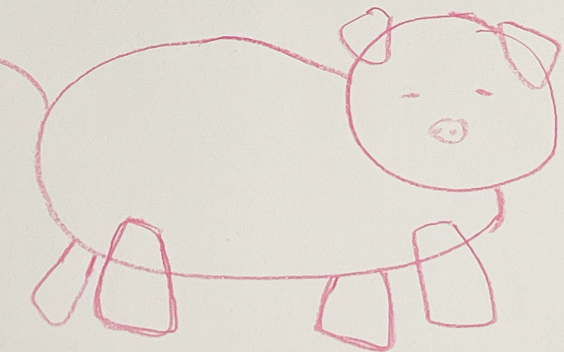

If you're interested in animating quadrupeds specifically, you may want to check out the quadruped example directory.
Creating Your Own Config Files
If you want to create your own config files, see the configuration file documentation.
Browser-Based Demo
If you'd like to animate a drawing of your own, but don't want to deal with downloading code and using the command line, check out our browser-based demo:
Paper & Citation
If you find the resources in this repo helpful, please consider citing the accompanying paper, A Method for Animating Children's Drawings of The Human Figure).
Citation:
@article{10.1145/3592788,
author = {Smith, Harrison Jesse and Zheng, Qingyuan and Li, Yifei and Jain, Somya and Hodgins, Jessica K.},
title = {A Method for Animating Childrenâs Drawings of the Human Figure},
year = {2023},
issue_date = {June 2023},
publisher = {Association for Computing Machinery},
address = {New York, NY, USA},
volume = {42},
number = {3},
issn = {0730-0301},
url = {https://doi.org/10.1145/3592788},
doi = {10.1145/3592788},
abstract = {Childrenâs drawings have a wonderful inventiveness, creativity, and variety to them. We present a system that automatically animates childrenâs drawings of the human figure, is robust to the variance inherent in these depictions, and is simple and straightforward enough for anyone to use. We demonstrate the value and broad appeal of our approach by building and releasing the Animated Drawings Demo, a freely available public website that has been used by millions of people around the world. We present a set of experiments exploring the amount of training data needed for fine-tuning, as well as a perceptual study demonstrating the appeal of a novel twisted perspective retargeting technique. Finally, we introduce the Amateur Drawings Dataset, a first-of-its-kind annotated dataset, collected via the public demo, containing over 178,000 amateur drawings and corresponding user-accepted character bounding boxes, segmentation masks, and joint location annotations.},
journal = {ACM Trans. Graph.},
month = {jun},
articleno = {32},
numpages = {15},
keywords = {2D animation, motion retargeting, motion stylization, Skeletal animation}
}
Amateur Drawings Dataset
To obtain the Amateur Drawings Dataset, run the following two commands from the command line:
# download annotations (~275Mb)
wget https://dl.fbaipublicfiles.com/amateur_drawings/amateur_drawings_annotations.json

# download images (~50Gb)
wget https://dl.fbaipublicfiles.com/amateur_drawings/amateur_drawings.tar
If you'd like higher res images, they can be found on the releases (ad_orig_img_fs). They've been split into multiple chunks using the split cli. They are released under the same license as the original dataset.
If you have feedback about the dataset, please fill out this form.
ChildlikeSHAPES
If you want this data set, construct the full archive from the chunks in the release page
cat datachunk_* > full_archive.7z #(pw=An1m8dR3610Ns)
Trained Model Weights
Trained model weights for human-like figure detection and pose estimation are included in the repo releases. Model weights are released under MIT license. The .mar files were generated using the OpenMMLab framework (OpenMMDet Apache 2.0 License, OpenMMPose Apache 2.0 License)
As-Rigid-As-Possible Shape Manipulation
These characters are deformed using As-Rigid-As-Possible (ARAP) shape manipulation. We have a Python implementation of the algorithm, located here, that might be of use to other developers.
License
Animated Drawings code, model weights, and Amateur Drawings dataset is released under the MIT license. ChildlikeSHAPES dataset is released under CC-BY 4.0 license.
Top Related Projects
T2I-Adapter
Let us control diffusion models!
A latent text-to-image diffusion model
CLIP (Contrastive Language-Image Pretraining), Predict the most relevant text snippet given an image
Cross-platform, customizable ML solutions for live and streaming media.
Convert designs to code with AI
Introducing Visual Copilot: A new AI model to turn Figma designs to high quality code using your components.
Try Visual Copilot