 Promptify
Prompt Engineering | Prompt Versioning | Use GPT or other prompt based models to get structured output. Join our discord for Prompt-Engineering, LLMs and other latest research
Top Related Projects

🤗 Transformers: the model-definition framework for state-of-the-art machine learning models in text, vision, audio, and multimodal models, for both inference and training.

DeepSpeed is a deep learning optimization library that makes distributed training and inference easy, efficient, and effective.

An open-source NLP research library, built on PyTorch.

Facebook AI Research Sequence-to-Sequence Toolkit written in Python.

TensorFlow code and pre-trained models for BERT

💫 Industrial-strength Natural Language Processing (NLP) in Python
Quick Overview
Promptify is an open-source Python library designed to streamline prompt engineering workflows. It offers a range of tools for creating, managing, and optimizing prompts for large language models, making it easier for developers to work with AI-powered applications.
Pros
- Simplifies prompt engineering with a user-friendly API
- Supports multiple language models, including OpenAI's GPT models
- Offers various prompt templates and techniques for different use cases
- Includes tools for prompt versioning and management
Cons
- Limited documentation and examples for some advanced features
- May require additional setup for certain language models
- Still in active development, so some features might be unstable
- Learning curve for users new to prompt engineering concepts
Code Examples
- Basic prompt generation:
from promptify import Promptify

prompter = Promptify()
prompt = prompter.text_to_prompt("Summarize this article about climate change.")
print(prompt)
- Using a specific prompt template:
from promptify import Promptify, PromptTemplate

template = PromptTemplate("Translate the following text to {language}: {text}")
prompter = Promptify()
prompt = prompter.from_template(template, language="French", text="Hello, world!")
print(prompt)
- Generating a response using OpenAI's GPT-3:
from promptify import Promptify, OpenAILanguageModel

model = OpenAILanguageModel(api_key="your_api_key")
prompter = Promptify(model=model)
response = prompter.generate("What is the capital of France?")
print(response)
Getting Started
To get started with Promptify, follow these steps:
- Install the library:
pip install promptify
- Import and initialize Promptify:
from promptify import Promptify

prompter = Promptify()
- Generate a simple prompt:
prompt = prompter.text_to_prompt("Write a short story about a robot.")
print(prompt)
For more advanced usage, refer to the Promptify documentation and examples in the GitHub repository.
Competitor Comparisons
🤗 Transformers: the model-definition framework for state-of-the-art machine learning models in text, vision, audio, and multimodal models, for both inference and training.
Pros of transformers
- Extensive library with support for a wide range of NLP tasks and models
- Well-documented and actively maintained by a large community
- Seamless integration with PyTorch and TensorFlow
Cons of transformers
- Steeper learning curve due to its comprehensive nature
- Can be resource-intensive for smaller projects or limited hardware
- May include unnecessary features for simple prompt engineering tasks
Code Comparison
transformers:
from transformers import pipeline

classifier = pipeline("sentiment-analysis")
result = classifier("I love this product!")[0]
print(f"Label: {result['label']}, Score: {result['score']:.4f}")
Promptify:
from promptify import Promptify

prompter = Promptify()
result = prompter.classify("I love this product!", ["positive", "negative"])
print(f"Label: {result['label']}, Score: {result['score']:.4f}")
Summary
While transformers offers a comprehensive suite of NLP tools and models, Promptify focuses specifically on prompt engineering and management. transformers is better suited for complex NLP tasks and research, while Promptify may be more appropriate for projects centered around prompt-based AI interactions. The choice between the two depends on the specific requirements of your project and the level of complexity you're willing to manage.
DeepSpeed is a deep learning optimization library that makes distributed training and inference easy, efficient, and effective.
Pros of DeepSpeed
- Focuses on optimizing deep learning training, offering significant speed improvements
- Supports a wide range of AI models and frameworks
- Provides advanced features like ZeRO optimizer and 3D parallelism
Cons of DeepSpeed
- Steeper learning curve due to its complexity and advanced features
- Primarily designed for large-scale AI training, may be overkill for smaller projects
Code Comparison
DeepSpeed:
import deepspeed
model_engine, optimizer, _, _ = deepspeed.initialize(args=args,
                                                     model=model,
                                                     model_parameters=params)
Promptify:
from promptify import Promptify
prompter = Promptify()
result = prompter.chat("Your prompt here", model="gpt-3.5-turbo")
Key Differences
- DeepSpeed is focused on optimizing deep learning training, while Promptify is designed for prompt engineering and management
- DeepSpeed offers more advanced features for large-scale AI training, whereas Promptify provides a simpler interface for working with language models
- DeepSpeed requires more setup and configuration, while Promptify aims for ease of use in prompt-based applications
An open-source NLP research library, built on PyTorch.
Pros of AllenNLP
- Comprehensive NLP toolkit with a wide range of pre-built models and components
- Extensive documentation and tutorials for ease of use
- Strong community support and regular updates
Cons of AllenNLP
- Steeper learning curve for beginners
- Primarily focused on research-oriented tasks
- Requires more setup and configuration for basic tasks
Code Comparison
AllenNLP:
from allennlp.predictors.predictor import Predictor

predictor = Predictor.from_path("https://storage.googleapis.com/allennlp-public-models/bert-base-srl-2020.03.24.tar.gz")
result = predictor.predict(sentence="Did Uriah honestly think he could beat the game in under three hours?")
Promptify:
from promptify import Promptify

prompt = Promptify()
result = prompt.ask("Summarize the following text: {text}", text="Your input text here")
AllenNLP provides a more structured approach for specific NLP tasks, while Promptify offers a simpler interface for prompt-based operations. AllenNLP requires more setup but offers greater flexibility for complex NLP tasks, whereas Promptify focuses on ease of use for prompt engineering and language model interactions.
Facebook AI Research Sequence-to-Sequence Toolkit written in Python.
Pros of fairseq
- Comprehensive toolkit for sequence modeling tasks
- Supports a wide range of architectures and models
- Highly optimized for performance and scalability
Cons of fairseq
- Steeper learning curve due to its complexity
- Requires more setup and configuration
- May be overkill for simpler NLP tasks
Code Comparison
fairseq:
from fairseq.models.transformer import TransformerModel
en2de = TransformerModel.from_pretrained(
    '/path/to/checkpoints',
    checkpoint_file='checkpoint_best.pt',
    data_name_or_path='data-bin/wmt16_en_de_bpe32k'
)
en2de.translate('Hello world!')
Promptify:
from promptify import Promptify
p = Promptify()
prompt = "Translate the following English text to French: 'Hello world!'"
response = p.generate(prompt)
print(response)
Summary
fairseq is a powerful and versatile toolkit for sequence modeling, offering a wide range of features and optimizations. However, it comes with a steeper learning curve and more complex setup. Promptify, on the other hand, provides a simpler interface for prompt-based tasks, making it easier to use for basic NLP operations but potentially lacking the advanced capabilities of fairseq.
TensorFlow code and pre-trained models for BERT
Pros of BERT
- Widely adopted and well-established pre-trained language model
- Extensive documentation and community support
- Proven performance on various NLP tasks
Cons of BERT
- Requires more computational resources for fine-tuning
- Less flexible for prompt engineering tasks
- Steeper learning curve for implementation
Code Comparison
BERT:
from transformers import BertTokenizer, BertModel
tokenizer = BertTokenizer.from_pretrained('bert-base-uncased')
model = BertModel.from_pretrained('bert-base-uncased')
inputs = tokenizer("Hello, my dog is cute", return_tensors="pt")
outputs = model(**inputs)
Promptify:
from promptify import Promptify
p = Promptify()
prompt = "Summarize the following text: {text}"
result = p.fit(prompt, text="Your input text here")
BERT focuses on tokenization and model loading for general NLP tasks, while Promptify simplifies prompt engineering with a more straightforward API. BERT requires more setup but offers greater flexibility, whereas Promptify provides a more user-friendly approach for specific prompt-based tasks.
💫 Industrial-strength Natural Language Processing (NLP) in Python
Pros of spaCy
- Mature, well-established library with extensive documentation and community support
- Offers a wide range of NLP functionalities beyond text processing
- Highly optimized for performance, suitable for large-scale production environments
Cons of spaCy
- Steeper learning curve due to its comprehensive feature set
- Requires more system resources and has a larger footprint
- Less focused on prompt engineering and LLM-specific tasks
Code Comparison
spaCy:
import spacy

nlp = spacy.load("en_core_web_sm")
doc = nlp("Apple is looking at buying U.K. startup for $1 billion")

for ent in doc.ents:
    print(ent.text, ent.label_)
Promptify:
from promptify import Promptify

p = Promptify()
text = "Apple is looking at buying U.K. startup for $1 billion"
result = p.ner(text, "en")

print(result)
Key Differences
- spaCy is a comprehensive NLP library, while Promptify focuses on prompt engineering and LLM interactions
- Promptify offers a simpler API for quick implementation of NLP tasks
- spaCy provides more granular control over NLP pipelines and models
- Promptify is designed to work seamlessly with various LLMs and prompt-based tasks
Convert  designs to code with AI

Introducing Visual Copilot: A new AI model to turn Figma designs to high quality code using your components.
Try Visual CopilotREADME

Promptify
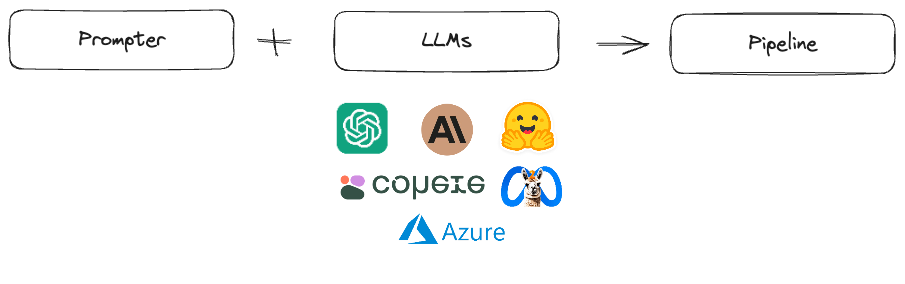
Task-based NLP engine with Pydantic structured outputs, built-in evaluation, and LiteLLM as the universal LLM backend. Think "scikit-learn for LLM-powered NLP".





Installation
With pip
Requires Python 3.9+.
pip install promptify
or
pip install git+https://github.com/promptslab/Promptify.git
For evaluation metrics support:
pip install promptify[eval]
Quick Tour
3-Line NER
from promptify import NER

ner = NER(model="gpt-4o-mini", domain="medical")
result = ner("The patient is a 93-year-old female with a medical history of chronic right hip pain, osteoporosis, hypertension, depression, and chronic atrial fibrillation admitted for evaluation and management of severe nausea and vomiting and urinary tract infection")
Output:
NERResult(entities=[
    Entity(text="93-year-old", label="AGE"),
    Entity(text="chronic right hip pain", label="CONDITION"),
    Entity(text="osteoporosis", label="CONDITION"),
    Entity(text="hypertension", label="CONDITION"),
    Entity(text="depression", label="CONDITION"),
    Entity(text="chronic atrial fibrillation", label="CONDITION"),
    Entity(text="severe nausea and vomiting", label="SYMPTOM"),
    Entity(text="urinary tract infection", label="CONDITION"),
])
Classification
from promptify import Classify

clf = Classify(model="gpt-4o-mini", labels=["positive", "negative", "neutral"])
result = clf("Amazing product! Best purchase I've ever made.")
# Classification(label="positive", confidence=0.95)
Question Answering
from promptify import QA

qa = QA(model="gpt-4o-mini")
answer = qa("Einstein was born in Ulm in 1879.", question="Where was Einstein born?")
# Answer(answer="Ulm", evidence="Einstein was born in Ulm", confidence=0.98)
Custom Task with Any Pydantic Schema
from promptify import Task
from pydantic import BaseModel

class MovieReview(BaseModel):
    sentiment: str
    rating: float
    key_themes: list[str]

task = Task(model="gpt-4o", output_schema=MovieReview, instruction="Analyze this movie review.")
review = task("Nolan's best work. Stunning visuals but the plot drags.")
# MovieReview(sentiment="mostly positive", rating=7.5, key_themes=["visuals", "pacing"])
Any Provider - Just Change the Model String
ner_openai = NER(model="gpt-4o-mini")
ner_claude = NER(model="claude-sonnet-4-20250514")
ner_local  = NER(model="ollama/llama3")
Batch Processing
results = ner.batch(["text1", "text2", "text3"], max_concurrent=10)
Async Support
result = await ner.acall("Patient has diabetes")
Built-in Evaluation
from promptify.eval import evaluate

scores = evaluate(task=ner, dataset=labeled_data, metrics=["precision", "recall", "f1"])
# {"precision": 0.92, "recall": 0.88, "f1": 0.90}
Features
- 2-3 lines of code for any NLP task -no training data required
- Pydantic structured outputs -type-safe results, not raw strings
- Any LLM provider via LiteLLM -OpenAI, Anthropic, Google, Ollama, Azure, and 100+ more
- Built-in tasks -NER, Classification (binary/multiclass/multilabel), QA, Summarization, Relation Extraction, SQL Generation, and more
- Custom tasks -bring your own Pydantic schema for any structured output
- Few-shot examples -easily add examples to improve accuracy
- Domain specialization -pass
domain="medical"or any domain for context-aware prompts - Batch processing -async concurrency under the hood for processing multiple texts
- Async support -native
awaitsupport withacall() - Evaluation framework -precision, recall, F1, accuracy, exact match, ROUGE metrics
- Safe parser -fallback JSON completion for providers without native structured outputs (no
eval()) - Cost tracking -built-in token usage and cost monitoring via
get_cost_summary()
Supported NLP Tasks
| Task | Class | Output Schema |
|---|---|---|
| Named Entity Recognition | NER | NERResult (list of Entity) |
| Binary Classification | Classify | Classification |
| Multiclass Classification | Classify | Classification |
| Multilabel Classification | Classify(multi_label=True) | MultiLabelResult |
| Question Answering | QA | Answer |
| Summarization | Summarize | Summary |
| Relation Extraction | ExtractRelations | ExtractionResult |
| Tabular Extraction | ExtractTable | ExtractionResult |
| Question Generation | GenerateQuestions | list of GeneratedQuestion |
| SQL Generation | GenerateSQL | SQLQuery |
| Text Normalization | NormalizeText | normalized text |
| Topic Modelling | ExtractTopics | list of topics |
| Custom Task | Task | any Pydantic BaseModel |
Community

@misc{Promptify2022,
  title = {Promptify: Structured Output from LLMs},
  author = {Pal, Ankit},
  year = {2022},
  howpublished = {\url{https://github.com/promptslab/Promptify}},
  note = {Prompt-Engineering components for NLP tasks in Python}
}
ð Contributing
We welcome any contributions to our open source project, including new features, improvements to infrastructure, and more comprehensive documentation. Please see the contributing guidelines
Top Related Projects
🤗 Transformers: the model-definition framework for state-of-the-art machine learning models in text, vision, audio, and multimodal models, for both inference and training.
DeepSpeed is a deep learning optimization library that makes distributed training and inference easy, efficient, and effective.
An open-source NLP research library, built on PyTorch.
Facebook AI Research Sequence-to-Sequence Toolkit written in Python.
TensorFlow code and pre-trained models for BERT
💫 Industrial-strength Natural Language Processing (NLP) in Python
Convert designs to code with AI
Introducing Visual Copilot: A new AI model to turn Figma designs to high quality code using your components.
Try Visual Copilot