 go-zero
A cloud-native Go microservices framework with cli tool for productivity.
Top Related Projects

A standard library for microservices.

Gin is a high-performance HTTP web framework written in Go. It provides a Martini-like API but with significantly better performance—up to 40 times faster—thanks to httprouter. Gin is designed for building REST APIs, web applications, and microservices.

High performance, minimalist Go web framework

⚡️ Express inspired web framework written in Go

Package gorilla/mux is a powerful HTTP router and URL matcher for building Go web servers with 🦍

beego is an open-source, high-performance web framework for the Go programming language.
Quick Overview
go-zero is a web and RPC framework with integrated tools to boost productivity in Go development. It's designed for building microservices, focusing on simplicity, performance, and reliability. The framework provides a comprehensive set of components for rapid development of distributed systems.
Pros
- Comprehensive toolkit for microservices development
- High performance and scalability
- Built-in service governance features (e.g., rate limiting, circuit breaking)
- Strong emphasis on code generation to reduce boilerplate
Cons
- Steeper learning curve for developers new to microservices architecture
- Opinionated structure may not fit all project requirements
- Limited documentation in English (primarily in Chinese)
- Relatively young project compared to some alternatives
Code Examples
- Defining an API using go-zero's API file:
type (
    LoginReq {
        Username string `json:"username"`
        Password string `json:"password"`
    }

    LoginResp {
        AccessToken string `json:"accessToken"`
        ExpiresIn   int64  `json:"expiresIn"`
    }
)

service user-api {
    @handler login
    post /user/login (LoginReq) returns (LoginResp)
}
- Implementing a simple HTTP handler:
func (l *LoginLogic) Login(req *types.LoginReq) (resp *types.LoginResp, err error) {
    // authentication logic here
    return &types.LoginResp{
        AccessToken: "generated_token",
        ExpiresIn:   3600,
    }, nil
}
- Using go-zero's built-in middleware:
server := rest.MustNewServer(c.RestConf, rest.WithMiddlewares(
    []rest.Middleware{
        middleware.Recover(),
        middleware.Metrics(),
    }...,
))
Getting Started
-
Install go-zero:
go get -u github.com/zeromicro/go-zero -
Create an API file (e.g.,
user.api):type ( RegisterReq { Username string `json:"username"` Password string `json:"password"` } RegisterResp { Message string `json:"message"` } ) service user-api { @handler register post /user/register (RegisterReq) returns (RegisterResp) } -
Generate code:
goctl api go -api user.api -dir . -
Implement the logic and run the service:
func main() {
    server := rest.MustNewServer(c.RestConf)
    defer server.Stop()
    server.Start()
}
Competitor Comparisons
A standard library for microservices.
Pros of go-kit
- More mature and established project with a larger community
- Highly modular and flexible architecture
- Extensive documentation and examples
Cons of go-kit
- Steeper learning curve due to its flexibility
- Requires more boilerplate code
- Less opinionated, which may lead to inconsistencies across projects
Code Comparison
go-kit example:
type Service interface {
    Hello(name string) (string, error)
}

func makeHelloEndpoint(svc Service) endpoint.Endpoint {
    return func(ctx context.Context, request interface{}) (interface{}, error) {
        req := request.(HelloRequest)
        v, err := svc.Hello(req.Name)
        return HelloResponse{v}, err
    }
}
go-zero example:
type (
    HelloReq struct {
        Name string `json:"name"`
    }

    HelloResp struct {
        Message string `json:"message"`
    }
)

@server(
    handler: HelloHandler
)
service hello-api {
    @handler Hello
    post /hello (HelloReq) returns (HelloResp)
}
go-kit offers more flexibility but requires more code, while go-zero provides a more streamlined approach with less boilerplate. go-kit is better suited for complex microservices architectures, whereas go-zero excels in rapid development and simplicity.
Gin is a high-performance HTTP web framework written in Go. It provides a Martini-like API but with significantly better performance—up to 40 times faster—thanks to httprouter. Gin is designed for building REST APIs, web applications, and microservices.
Pros of gin
- Lightweight and minimalistic, offering high performance
- Easy to learn and use, with a simple API
- Extensive middleware ecosystem
Cons of gin
- Limited built-in features for complex microservices
- Lacks integrated tools for API documentation and testing
- Requires additional libraries for advanced functionalities
Code Comparison
gin:
r := gin.Default()
r.GET("/ping", func(c *gin.Context) {
    c.JSON(200, gin.H{"message": "pong"})
})
r.Run()
go-zero:
type Config struct {
    rest.RestConf
}
type Service struct {
    c Config
}
func NewService(c Config) *Service {
    return &Service{c: c}
}
go-zero is a more comprehensive microservices framework, offering built-in features for distributed systems, while gin is a lightweight web framework focused on simplicity and performance. go-zero provides tools for service discovery, load balancing, and API documentation out of the box, whereas gin requires additional libraries for these functionalities. gin's simplicity makes it easier to learn and use for smaller projects, while go-zero's extensive feature set is better suited for complex microservices architectures.
High performance, minimalist Go web framework
Pros of Echo
- Lightweight and minimalist framework, offering simplicity and ease of use
- Excellent performance with low overhead
- Extensive middleware support and easy customization
Cons of Echo
- Less opinionated, requiring more manual setup for larger projects
- Fewer built-in features compared to go-zero's comprehensive toolkit
- Limited code generation capabilities
Code Comparison
Echo:
e := echo.New()
e.GET("/", func(c echo.Context) error {
    return c.String(http.StatusOK, "Hello, World!")
})
e.Logger.Fatal(e.Start(":1323"))
go-zero:
type Config struct {
    rest.RestConf
}
func main() {
    var c Config
    conf.MustLoad("config.yaml", &c)
    server := rest.MustNewServer(c.RestConf)
    defer server.Stop()
    server.Start()
}
Echo provides a more straightforward setup for simple applications, while go-zero offers a more structured approach with built-in configuration management. Echo's routing is more concise, but go-zero provides additional features like automatic API documentation and microservices support out of the box.
Both frameworks have their strengths, with Echo excelling in simplicity and performance for smaller projects, and go-zero offering a more comprehensive toolkit for building complex, scalable microservices.
⚡️ Express inspired web framework written in Go
Pros of Fiber
- Extremely fast performance due to its lightweight design and use of the fasthttp library
- Simple and expressive API, making it easy for developers to quickly build web applications
- Extensive middleware ecosystem and built-in features like WebSocket support
Cons of Fiber
- Less comprehensive than go-zero, focusing primarily on HTTP routing and middleware
- Smaller community and ecosystem compared to more established frameworks
- Limited built-in support for microservices architecture and related patterns
Code Comparison
Fiber:
app := fiber.New()
app.Get("/", func(c *fiber.Ctx) error {
    return c.SendString("Hello, World!")
})
app.Listen(":3000")
go-zero:
type Config struct {
    rest.RestConf
}
func main() {
    var c Config
    conf.MustLoad("config.yaml", &c)
    server := rest.MustNewServer(c.RestConf)
    defer server.Stop()
    server.Start()
}
Fiber offers a more concise and straightforward setup for basic HTTP servers, while go-zero provides a more structured approach with built-in configuration management and microservices support. go-zero is better suited for complex, large-scale applications, while Fiber excels in simplicity and raw performance for smaller projects or microservices.
Package gorilla/mux is a powerful HTTP router and URL matcher for building Go web servers with 🦍
Pros of mux
- Lightweight and focused on HTTP routing
- Simple and easy to learn for beginners
- Widely adopted and battle-tested in production environments
Cons of mux
- Limited built-in features compared to go-zero's comprehensive toolkit
- Requires additional libraries for more advanced functionality
- Less suitable for large-scale microservices architectures
Code Comparison
mux:
r := mux.NewRouter()
r.HandleFunc("/api/{key}", handler).Methods("GET")
http.ListenAndServe(":8080", r)
go-zero:
type Config struct {
    rest.RestConf
}
s := rest.MustNewServer(c.RestConf)
s.HandleFunc("/api/{key}", handler)
s.Start()
Key Differences
- go-zero provides a more comprehensive toolkit for microservices development
- mux focuses primarily on HTTP routing and is more lightweight
- go-zero includes built-in support for service discovery, load balancing, and distributed tracing
- mux requires additional libraries for advanced features like middleware and validation
- go-zero offers code generation tools for rapid development, while mux relies on manual implementation
Both libraries have their strengths and are suitable for different use cases. mux is ideal for simpler web applications, while go-zero is better suited for complex microservices architectures.
beego is an open-source, high-performance web framework for the Go programming language.
Pros of Beego
- More mature and established framework with a larger community
- Comprehensive documentation and extensive learning resources
- Built-in ORM for database operations
Cons of Beego
- Heavier and more opinionated framework, which may lead to less flexibility
- Steeper learning curve for beginners due to its full-stack nature
- Less focus on microservices architecture compared to Go-Zero
Code Comparison
Beego routing example:
beego.Router("/", &controllers.MainController{})
beego.Router("/api/list", &controllers.APIController{}, "get:List")
beego.Run()
Go-Zero routing example:
server := rest.MustNewServer(c.RestConf)
handler.RegisterHandlers(server, ctx)
server.Start()
Both frameworks offer easy-to-use routing mechanisms, but Go-Zero's approach is more concise and focused on microservices. Beego provides a more traditional MVC-style routing, while Go-Zero emphasizes simplicity and performance for distributed systems.
Go-Zero is designed specifically for microservices, offering features like built-in service discovery and load balancing. Beego, on the other hand, is a full-stack web framework that can be used for various types of applications, including monolithic ones.
Convert  designs to code with AI
Introducing Visual Copilot: A new AI model to turn Figma designs to high quality code using your components.
Try Visual CopilotREADME
go-zero

go-zero is a web and rpc framework with lots of builtin engineering practices. Itâs born to ensure the stability of the busy services with resilience design and has been serving sites with tens of millions of users for years.






ð¤·â What is go-zero?
English | ç®ä½ä¸æ | íêµì´

go-zero (listed in CNCF Landscape: https://landscape.cncf.io/?selected=go-zero) is a web and rpc framework with lots of builtin engineering practices. Itâs born to ensure the stability of the busy services with resilience design and has been serving sites with tens of millions of users for years.
go-zero contains simple API description syntax and code generation tool called goctl. You can generate Go, iOS, Android, Kotlin, Dart, TypeScript, JavaScript from .api files with goctl.
Advantages of go-zero:
- Improves the stability of the services with tens of millions of daily active users
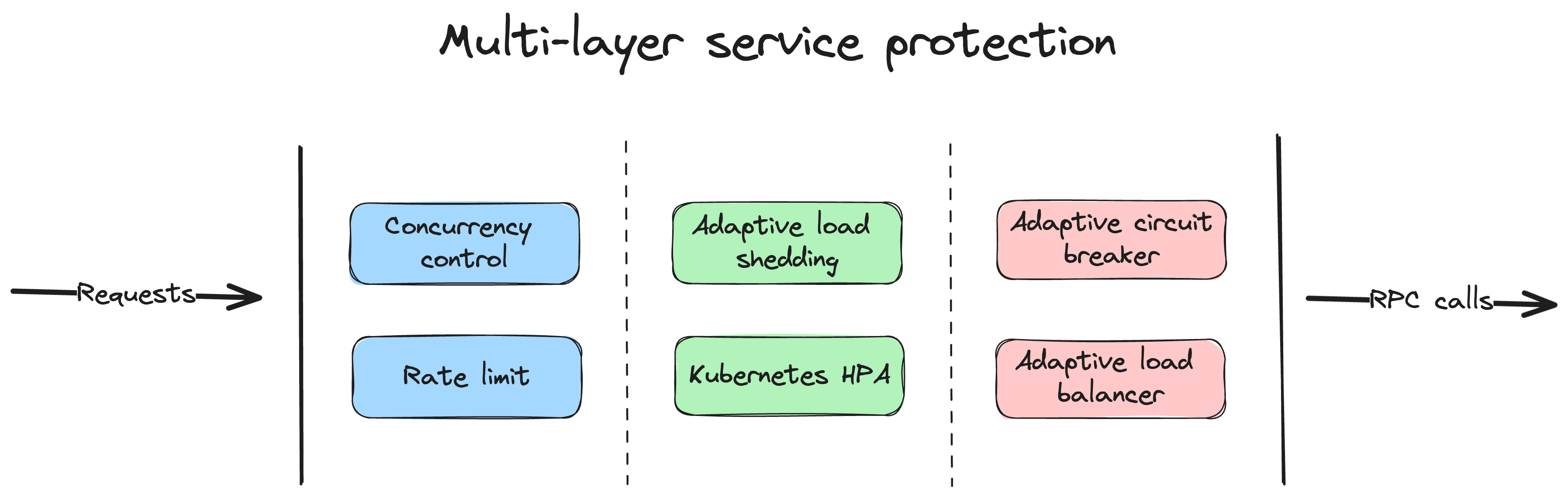
- Builtin chained timeout control, concurrency control, rate limit, adaptive circuit breaker, adaptive load shedding, even no configuration needed
- Builtin middlewares also can be integrated into your frameworks
- Simple API syntax, one command to generate a couple of different languages
- Auto validate the request parameters from clients
- Plenty of builtin microservice management and concurrent toolkits
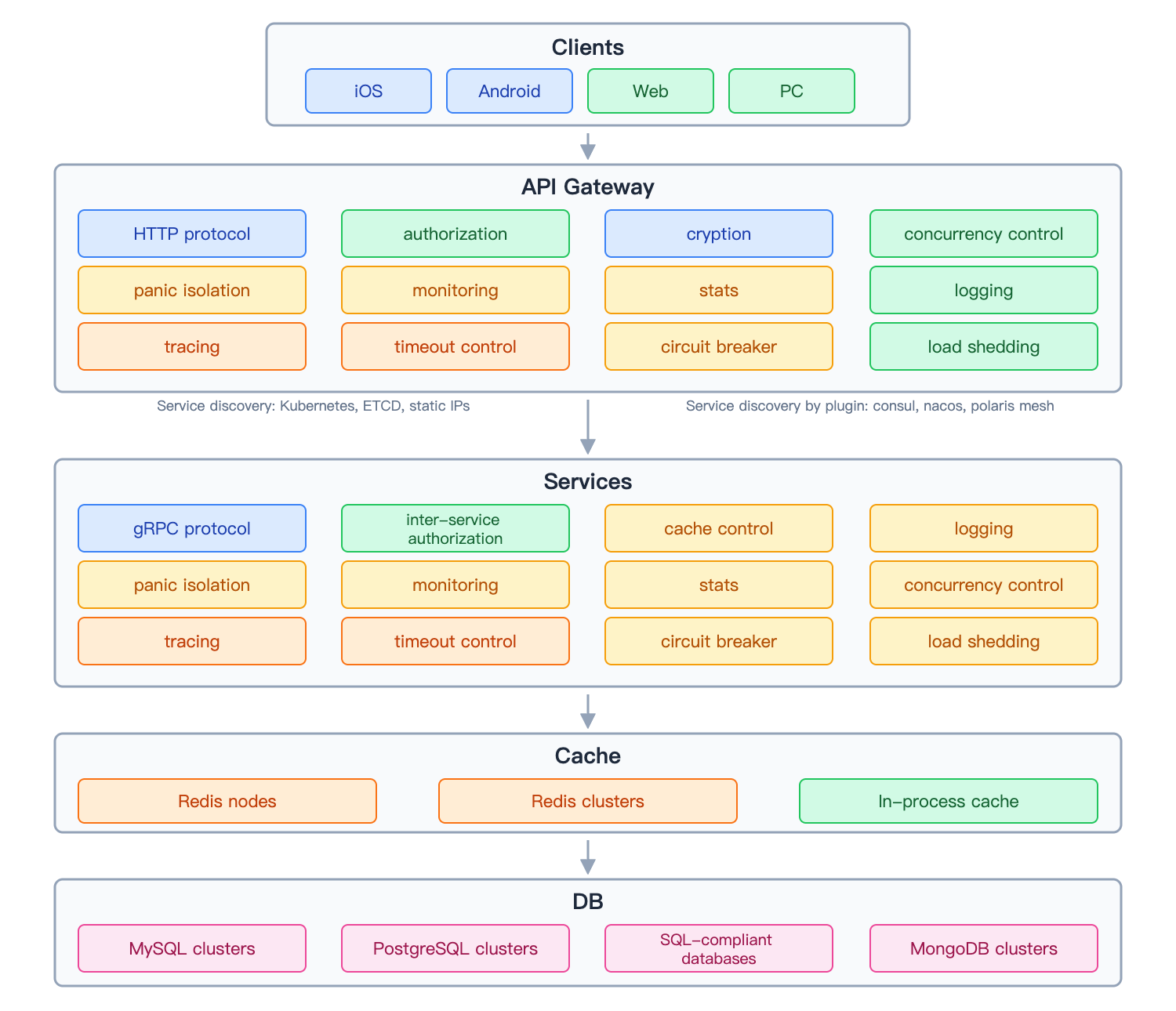
Backgrounds of go-zero
In early 2018, we transitioned from a Java+MongoDB monolithic architecture to microservices, choosing:
- Golang - High performance, simple syntax, excellent deployment experience, and low resource consumption
- Self-designed microservice framework - Better problem isolation, easier feature extension, and faster issue resolution
Design considerations on go-zero
go-zero follows these core design principles:
- Simplicity - Keep it simple, first principle
- High availability - Stable under high concurrency
- Resilience - Failure-oriented programming with adaptive protection
- Developer friendly - Encapsulate complexity, one way to do one thing
- Easy to extend - Flexible architecture for growth
The implementation and features of go-zero
go-zero integrates engineering best practices:
- Code generation - Powerful tools to minimize boilerplate
- Simple API - Clean interfaces, fully compatible with net/http
- High performance - Optimized for speed and efficiency
- Resilience - Built-in circuit breaker, rate limiting, load shedding, timeout control
- Service mesh - Service discovery, load balancing, call tracing
- Developer tools - Auto parameter validation, cache management, metrics and monitoring
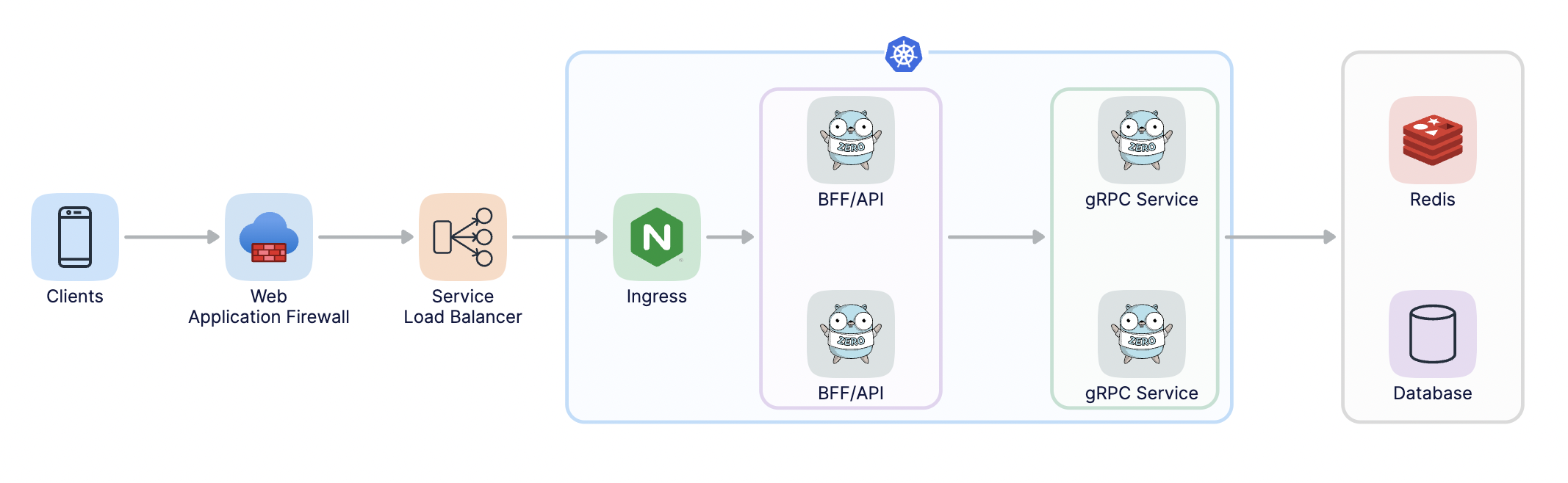
Architecture with go-zero
Installation
Run the following command under your project:
go get -u github.com/zeromicro/go-zero
AI-Native Development
The go-zero team provides AI tooling for Claude, GitHub Copilot, Cursor to generate framework-compliant code.
Three Core Projects
ai-context - Workflow guide for AI assistants
zero-skills - Pattern library with examples
mcp-zero - Code generation tools via Model Context Protocol
Quick Setup
GitHub Copilot
git submodule add https://github.com/zeromicro/ai-context.git .github/ai-context
ln -s ai-context/00-instructions.md .github/copilot-instructions.md  # macOS/Linux
# Windows: mklink .github\copilot-instructions.md .github\ai-context\00-instructions.md
git submodule update --remote .github/ai-context  # Update
Cursor
git submodule add https://github.com/zeromicro/ai-context.git .cursorrules
git submodule update --remote .cursorrules  # Update
Windsurf
git submodule add https://github.com/zeromicro/ai-context.git .windsurfrules
git submodule update --remote .windsurfrules  # Update
Claude Desktop
git clone https://github.com/zeromicro/mcp-zero.git && cd mcp-zero && go build
# Configure: ~/Library/Application Support/Claude/claude_desktop_config.json
# Or: claude mcp add --transport stdio mcp-zero --env GOCTL_PATH=/path/to/goctl -- /path/to/mcp-zero
How It Works
AI assistants use these tools together:
- ai-context - workflow guidance
- zero-skills - implementation patterns
- mcp-zero - real-time code generation
Example: Creating a REST API â AI reads ai-context for workflow â calls mcp-zero to generate code â references zero-skills for patterns â produces production-ready code â
Quick Start
-
Full examples:
-
Install goctl
# for Go
go install github.com/zeromicro/go-zero/tools/goctl@latest

# For Mac
brew install goctl

# docker for all platforms
docker pull kevinwan/goctl
# run goctl
docker run --rm -it -v `pwd`:/app kevinwan/goctl --help
Ensure goctl is executable and in your $PATH.
-
Create the API file (greet.api):
type (
  Request {
    Name string `path:"name,options=[you,me]"` // parameters are auto validated
  }

  Response {
    Message string `json:"message"`
  }
)

service greet-api {
  @handler GreetHandler
  get /greet/from/:name(Request) returns (Response)
}
Generate .api template:
goctl api -o greet.api -
Generate Go server code
goctl api go -api greet.api -dir greetGenerated structure:
âââ greet â  âââ etc â  â  âââ greet-api.yaml // configuration file â  âââ greet.go // main file â  âââ internal â  âââ config â  â  âââ config.go // configuration definition â  âââ handler â  â  âââ greethandler.go // get/put/post/delete routes are defined here â  â  âââ routes.go // routes list â  âââ logic â  â  âââ greetlogic.go // request logic can be written here â  âââ svc â  â  âââ servicecontext.go // service context, mysql/redis can be passed in here â  âââ types â  âââ types.go // request/response defined here âââ greet.api // api description fileRun the service:
cd greet
go mod tidy
go run greet.go -f etc/greet-api.yaml
Default port: 8888 (configurable in etc/greet-api.yaml)
Test with curl:
curl -i http://localhost:8888/greet/from/youResponse:
HTTP/1.1 200 OK Date: Sun, 30 Aug 2020 15:32:35 GMT Content-Length: 0 -
Write business logic
- Pass dependencies (mysql, redis, etc.) via servicecontext.go
- Add logic code in the logic package per .api definition
-
Generate client code for multiple languages
goctl api java -api greet.api -dir greet
goctl api dart -api greet.api -dir greet
...
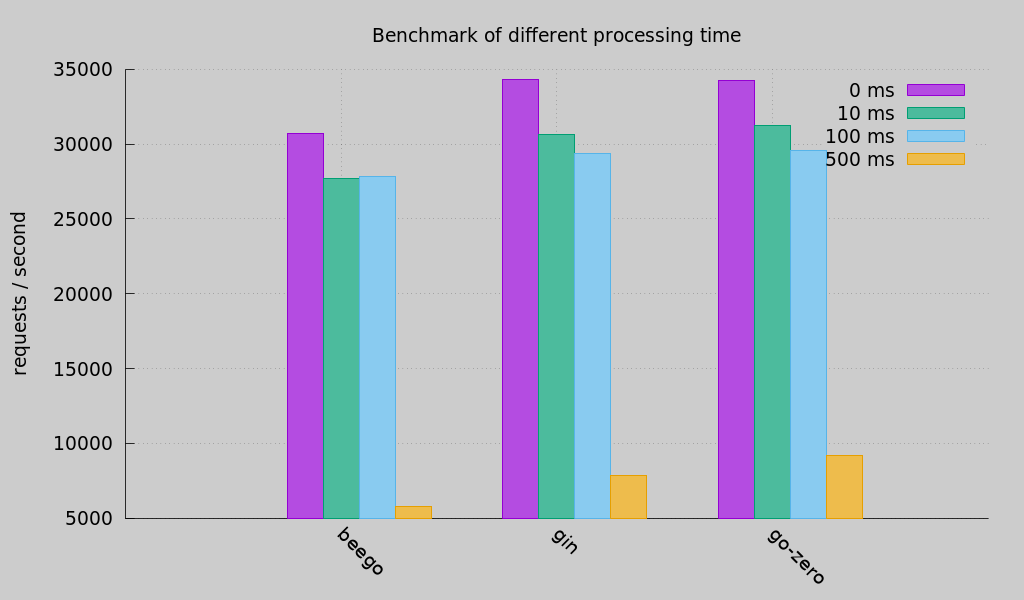
Benchmark
Documents
- Documents
- Rapid development of microservice systems
- Rapid development of microservice systems - multiple RPCs
- Examples
Chat group
Join the chat via https://discord.gg/4JQvC5A4Fe
Cloud Native Landscape


go-zero enlisted in the CNCF Cloud Native Landscape.
Give a Star! â
If you like this project or are using it to learn or start your own solution, give it a star to get updates on new releases. Your support matters!
Top Related Projects
A standard library for microservices.
Gin is a high-performance HTTP web framework written in Go. It provides a Martini-like API but with significantly better performance—up to 40 times faster—thanks to httprouter. Gin is designed for building REST APIs, web applications, and microservices.
High performance, minimalist Go web framework
⚡️ Express inspired web framework written in Go
Package gorilla/mux is a powerful HTTP router and URL matcher for building Go web servers with 🦍
beego is an open-source, high-performance web framework for the Go programming language.
Convert designs to code with AI
Introducing Visual Copilot: A new AI model to turn Figma designs to high quality code using your components.
Try Visual Copilot